
Water Well Running Dry: Why Does It Happen?
A water well running dry can become a serious problem for a rural villa, particularly during the hot summer months when water demand is at its highest.
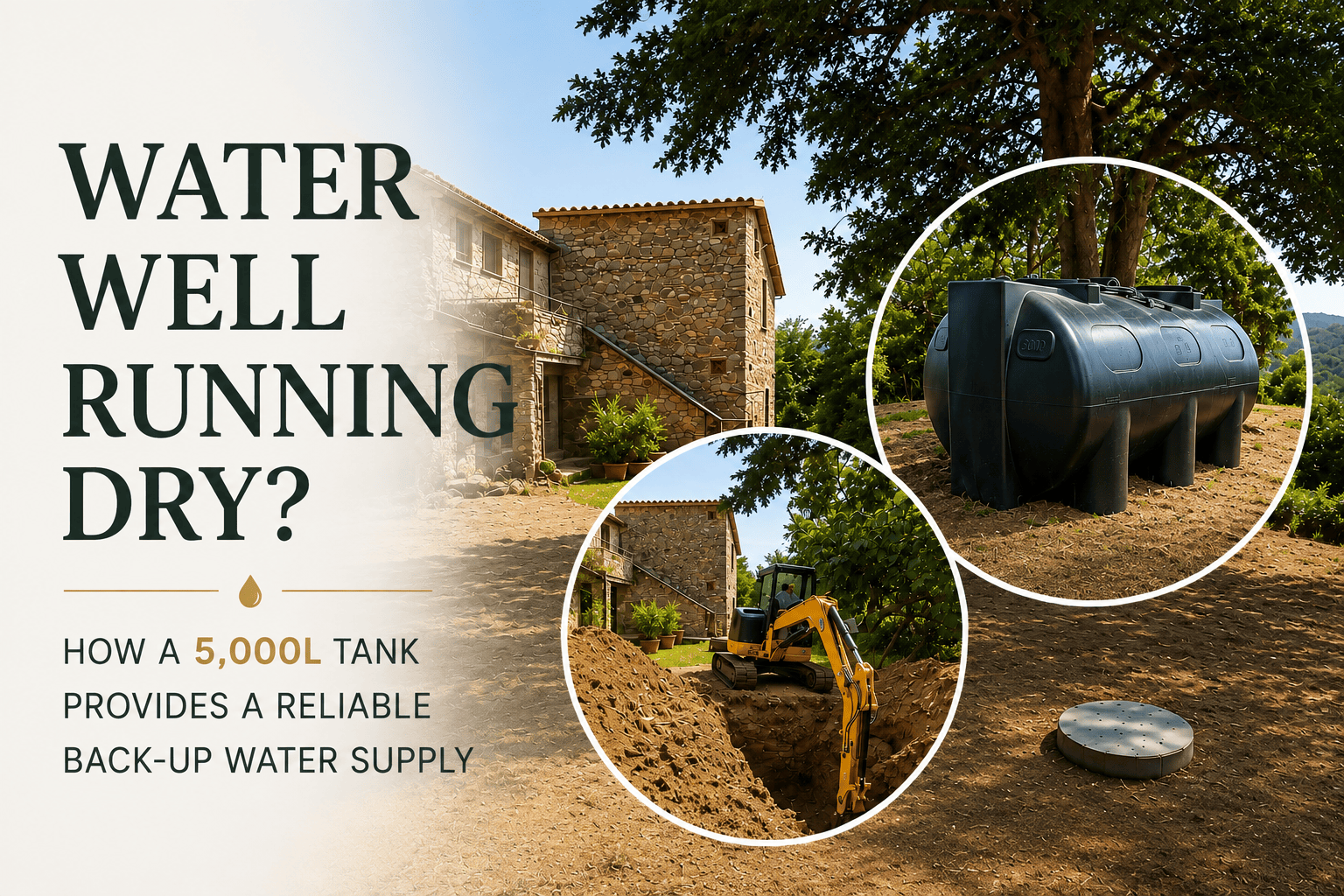
How a 5,000 Litre Back-Up Tank Provided a Reliable Water Supply
This was the situation at one of the villas we look after in Umbria.
The property has had its well for more than 30 years and, until recently, it had provided a reliable water supply. However, earlier this year, it became clear that the well was no longer recovering as quickly as it once had.
The solution was not simply to hope for the best.
A 5,000-litre reserve tank was installed to provide a back-up water supply and give the well time to recover when needed.
This is the story of what happened, why wells can run dry, and how a practical solution was put in place.
Why can a water well suddenly run dry?
There is not always one simple answer.
A well that has worked perfectly for 20 or 30 years can begin to struggle for several reasons. In this case, the property was probably one of the only villas in the immediate area when the well was originally established. Over the years, however, the surrounding area has changed.
Possible reasons include:
- Long periods of dry weather and low rainfall
- The underground water table naturally dropping
- Increased use of water at the property
- More properties being built in the surrounding area
- Other wells drawing from the same underground water sources
- Changes to the natural flow of groundwater over time
- The well simply no longer replenishing as quickly as it once did
We have also seen and heard of more wells drying out locally this year. Our plumber has mentioned similar problems at other properties, suggesting that this may not be an isolated issue.
The truth is, we cannot say with certainty which of these factors is responsible for this particular well. What we do know is that the water supply needed to be managed carefully.
The problem was identified while the owner was at the property
Fortunately, the owner was staying at the villa when the problem became apparent, so they were able to see and understand exactly what was happening.
This was during March and April, when the well was struggling to keep up with water usage.
The owner understood that something needed to be done before the busy rental period.
The owner controls the villa’s booking calendar and decided to block off a period after their stay. We were given the dates of the next guest arrival and departure, which allowed us to plan the work around the one-month gap between the owner’s departure and the next guests arriving.
That month gave us the time needed to organise the equipment, arrange delivery and complete the installation.
This was important because a project like this cannot simply be completed overnight.
The tank had to be ordered and delivered, the ground prepared, the installation completed and the system connected and tested before the next guests arrived.
The solution: a 5,000-litre reserve tank
The decision was made to install a 5,000-litre underground reserve tank next to the existing well.
The purpose of the tank is not to replace the well.
The well remains the main water source.
Instead, the reserve tank provides an important back-up system.
When the well is producing water, water can be transferred into the reserve tank. If the well begins to struggle or needs time to recover, the property has an additional supply available.
If the well runs dry again, water can also be delivered to refill the reserve tank while the well is given time to replenish.
That means the property is no longer completely dependent on the well recovering quickly enough to meet immediate demand.
The installation process
Installing a 5,000-litre tank was a substantial job.
First, a large hole had to be excavated next to the existing well.
Once the excavation was complete, the tank was delivered and carefully positioned underground.
The installation then involved:
- Digging the excavation beside the well.
- Delivering the 5,000-litre reserve tank.
- Positioning the tank securely in the ground.
- Connecting the system so water from the well could be added to the reserve tank.
- Filling the tank with water from the well.
- Backfilling around the tank.
- Completing the electrical connections.
- Testing the system to make sure everything was working correctly.
The result is a practical reserve water system that gives the property an additional level of protection.
It is not the prettiest garden at the moment
One part of the project has deliberately been left until later.
The excavation and installation work obviously disturbed part of the garden, and the grass has not yet been replaced.
It is currently the middle of a hot Umbrian summer.
Trying to establish new grass now would mean using additional water to keep it alive. Not only would that place more pressure on the water supply, but regular watering could also be disruptive for guests.
So, for now, it is soil.
Is it beautiful? No.
Is it sensible? Absolutely.
At the moment, the priority is protecting the villa’s water supply.
We would rather have a garden that needs some attention later than a beautiful patch of grass and no water.
The garden can be restored when the weather is more suitable and the grass has a realistic chance of establishing itself without placing unnecessary demand on the water supply.
A reserve tank does not mean unlimited water
This is probably the most important part of the whole story.
Installing a 5,000-litre reserve tank provides reassurance, but it does not create an endless supply of water.
We still do not know exactly how quickly the well will recover or how badly it may be affected during particularly dry periods.
For that reason, the water supply still needs to be managed carefully.
The reserve tank is there to provide breathing space and protection. It is not a reason to stop being cautious.
Managing water use at the villa
We have had to look carefully at where and when water is being used.
The irrigation system, for example, is now managed carefully.
Garden watering should take place at night, when guests are sleeping, and only for a short period.
This helps reduce unnecessary demand during the day and gives the well a better opportunity to recover.
The same approach applies when the pool is being cleaned.
Water should only be used for the necessary period and, wherever possible, this work should be carried out when there are no guests at the property.
Small changes like these can make a significant difference when a private water supply is under pressure.
How quickly can water be used?
It can be surprisingly easy to use a large amount of water without realising it.
For example, approximate water usage can include:
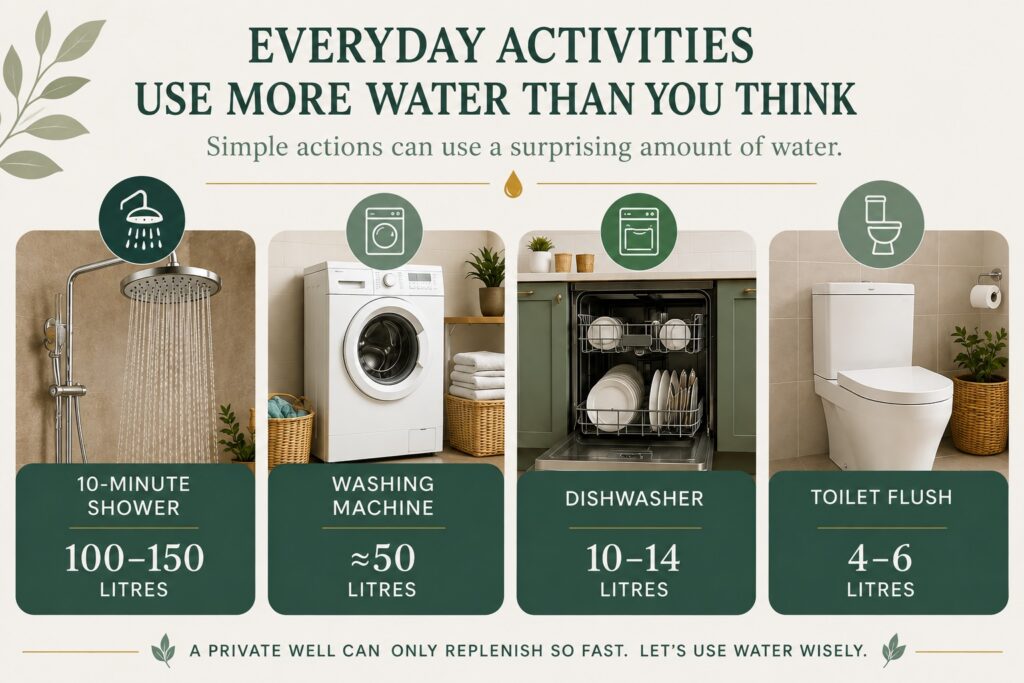
These figures are only examples and actual usage depends on the appliance, shower flow rate and plumbing system.
However, they demonstrate how quickly water use can add up when several people are staying in a villa.
A real example from this villa
Recently, seven people were staying at the property.
By Saturday lunchtime, the 5,000-litre reserve tank was empty.
The guests reported that they had only used the washing machine, dishwasher and had taken one 10-minute shower.
However, water had clearly been used elsewhere in the property, because those activities alone would not account for 5,000 litres.
The important point is that water can be used in ways people do not always notice or remember, particularly when several guests are sharing a property.
Everyone had been specifically asked to be careful with water, but unfortunately the reserve supply still emptied.
The good news was that the system was then left to rest overnight.
By the following morning, the tank was approximately half full again.
This showed that the well was still producing water, but also demonstrated why careful water management is so important.
If demand is greater than the rate at which the well can replenish the system, eventually the available water will run out.
What happens if the tank runs dry?
This is exactly why the reserve system was installed.
If the water level drops significantly or the tank runs dry, the first step is to reduce water usage and give the well time to recover.
The well can then continue replenishing the reserve system without additional demand being placed on it.
If necessary, water can also be delivered to refill the 5,000-litre reserve tank.
This provides an emergency supply while the well is given time to rest and replenish naturally.
Having the tank means there is now an additional option available.
Without it, a dry well could potentially leave the property without a reliable water supply while waiting for the underground water source to recover.
Guests are asked to be mindful before they arrive
Guests are now informed before arrival that the villa uses a private water supply.
They are asked to be sensible with their water usage, avoid unnecessarily long showers and be mindful that well water is not an unlimited supply.
This does not mean guests cannot enjoy their holiday.
It simply means understanding that a private water system works differently from a property connected to an unlimited mains supply.
A little awareness from everyone staying at the villa can help protect the water supply for the entire group.
The importance of having a back-up plan
This project is a good example of why property management is often about dealing with situations that nobody planned for.
The well had served the property for decades.
Nobody could say exactly when or why it would begin struggling.
But once the problem became clear, a practical solution was needed.
The owner recognised the issue, blocked the booking calendar to allow the work to take place and gave us the time needed to organise and manage the project.
The result is now a 5,000-litre reserve system that provides an important safety net.
The property still needs to be careful with water.
The irrigation needs to be controlled.
Pool maintenance needs to be managed sensibly.
Guests need to understand that water should not be wasted.
And the well itself still needs time to replenish.
But if the well struggles again, the property now has options.
The reserve tank can provide additional water while the well recovers, and if necessary, water can be delivered to refill the tank.
We cannot control the weather.
Sometimes the best solution is preparation
We cannot control underground water levels.
And we cannot always know exactly why a well that has worked for decades suddenly begins to struggle.
What we can do is prepare.
In this case, preparation meant identifying the problem, planning the work around the villa’s bookings, excavating the site, installing a 5,000-litre reserve tank and putting a more careful water management system in place.
The result may not look perfect yet.
There is still soil where the garden will eventually be restored.
But the priority was never a perfect lawn.
The priority was water.
And for a villa that relies on a private well, that makes all the difference.
And the garden? Now that summer is nearly over, we can start the landscaping and get the area looking as it should. Next year, it should be burnt grass rather than mud!
Leave a Reply